RNA Molecules in Cancer Types
RNA molecules play a critical role in gene expression, cell growth, differentiation, apoptosis, and tumor progression.
Abnormal expression or mutations of different RNA types can contribute to cancer development, metastasis, and resistance to therapy.
These RNA molecules are increasingly
used as diagnostic biomarkers, prognostic indicators, and therapeutic targets in precision oncology.
Major Types of RNA Involved in Cancer
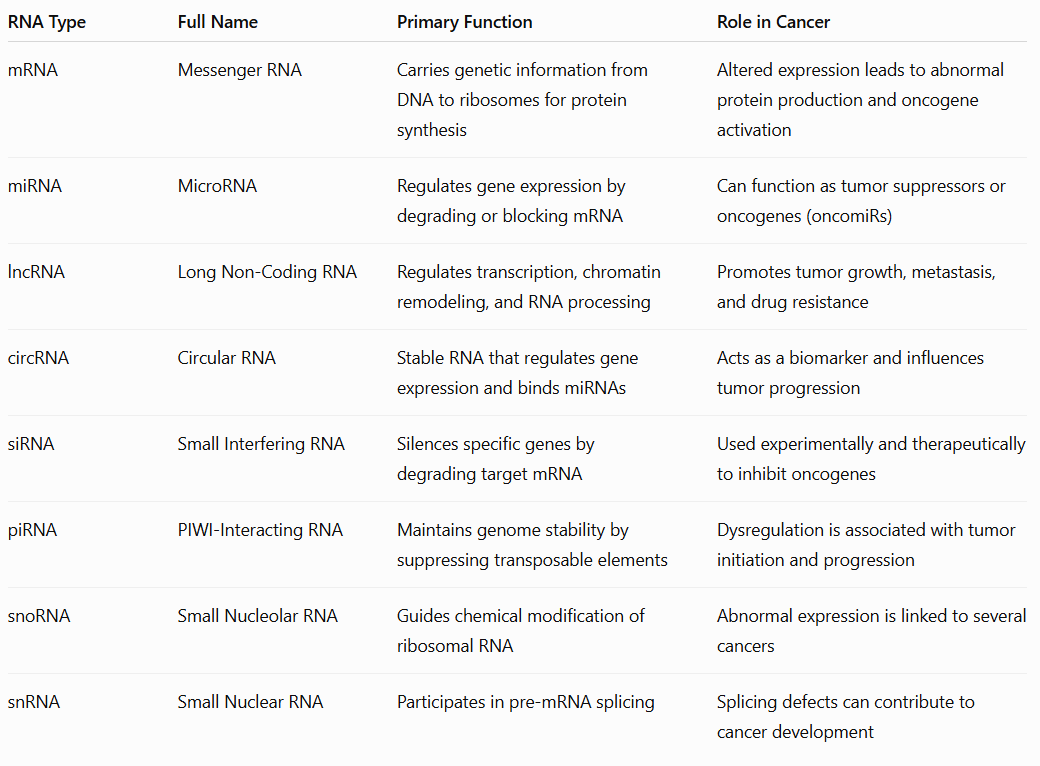
1. Messenger RNA (mRNA)
Function
Transfers genetic information from DNA to ribosomes.
Directs protein synthesis.
Role in Cancer
Overexpression of oncogene mRNAs increases production of proteins that promote tumor growth.
Reduced expression of tumor suppressor mRNAs decreases protective proteins.
mRNA profiling helps classify tumors and guide targeted therapy.
Clinical Applications
Gene expression profiling
Precision medicine
Biomarker discovery
Monitoring treatment response
2. MicroRNA (miRNA)
Function
Small (approximately 22 nucleotides) non-coding RNAs that regulate gene expression by binding target mRNAs.
Role in Cancer
Tumor-suppressor miRNAs inhibit oncogenes.
Oncogenic miRNAs (oncomiRs) suppress tumor suppressor genes.
Influence cell proliferation, apoptosis, angiogenesis, invasion, and metastasis.
Examples
miR-21 – commonly overexpressed in many cancers.
let-7 – suppresses oncogene expression.
miR-34 – regulated by p53 and promotes apoptosis.
3. Long Non-Coding RNA (lncRNA)
Function
Longer than 200 nucleotides.
Regulates chromatin organization, transcription, RNA stability, and protein interactions.
Role in Cancer
Promotes proliferation
Increases metastasis
Regulates epithelial–mesenchymal transition (EMT)
Contributes to chemotherapy resistance
Examples
HOTAIR – associated with metastasis.
MALAT1 – linked to tumor progression.
PVT1 – involved in multiple cancers.
4. Circular RNA (circRNA)
Function
Covalently closed RNA molecules with high stability.
Often act as "sponges" for miRNAs, affecting gene regulation.
Role in Cancer
Regulate tumor growth
Promote invasion and metastasis
Serve as stable biomarkers detectable in blood
Clinical Importance
Early cancer diagnosis
Prognostic marker
Therapeutic target
5. Small Interfering RNA (siRNA)
Function
Binds complementary mRNA and induces its degradation.
Produces highly specific gene silencing.
Role in Cancer
Experimental and therapeutic suppression of oncogenes.
Can reduce expression of genes involved in tumor growth and angiogenesis.
Clinical Applications
RNA-based targeted therapies
Nanoparticle-mediated drug delivery
Personalized medicine
6. PIWI-Interacting RNA (piRNA)
Function
Interacts with PIWI proteins to silence transposable elements and protect genome integrity.
Role in Cancer
Dysregulated expression affects:
Cell proliferation
Invasion
Metastasis
Genome stability
7. Small Nucleolar RNA (snoRNA)
Function
Guides chemical modification and maturation of ribosomal RNA (rRNA).
Role in Cancer
Altered expression influences protein synthesis.
Associated with breast, lung, prostate, and colorectal cancers.
8. Small Nuclear RNA (snRNA)
Function
Essential component of the spliceosome.
Removes introns from pre-mRNA during RNA splicing.
Role in Cancer
Abnormal splicing creates altered protein variants that can drive cancer progression.
RNA Molecules in Different Cancer Types