DNA Mutations in Cancer Types
DNA mutations are permanent changes in the genetic sequence that disrupt normal cellular processes such as cell growth, DNA repair,
apoptosis, and differentiation. In cancer, these mutations accumulate over time and can activate oncogenes, inactivate tumor suppressor genes,
or impair
DNA repair mechanisms, ultimately leading to uncontrolled cell proliferation and tumor development.
Types of DNA Mutations
1. Point Mutations (Single Nucleotide Variants)
point mutation is the alteration of a single nucleotide in the DNA sequence.
Functions/Effects:
May activate oncogenes or inactivate tumor suppressor genes.
Can alter protein structure or function.
Often serve as therapeutic biomarkers.
Examples:
KRAS mutations in colorectal, pancreatic, and lung cancers
BRAF V600E mutation in melanoma and thyroid cancer
TP53 mutations in many solid tumors
2. Insertions and Deletions (Indels)
Insertions add nucleotides to DNA, while deletions remove nucleotides. These mutations may shift the reading frame (frameshift mutation),
producing abnormal proteins.
Functions/Effects:
Generate truncated or nonfunctional proteins.
Frequently disrupt tumor suppressor genes.
Can create novel therapeutic targets.
Examples:
BRCA1 and BRCA2 mutations
EGFR exon 19 deletion in non-small cell lung cancer
3. Gene Amplification
Gene amplification refers to an increase in the number of copies of a gene, resulting in overexpression of the encoded protein.
Functions/Effects:
Enhances cell proliferation.
Promotes tumor growth.
Often predicts response to targeted therapies.
Examples:
HER2 amplification in breast and gastric cancers
MYC amplification in several cancers
4. Chromosomal Translocations
chromosomal translocation occurs when segments from two different chromosomes exchange places, producing fusion genes with abnormal functions.
Functions/Effects:
Constitutively activate signaling pathways.
Drive uncontrolled proliferation.
Serve as diagnostic markers.
Examples:
BCR-ABL in chronic myeloid leukemia
PML-RARA
5. Copy Number Variations (CNVs)
CNVs involve gains or losses of large DNA segments containing one or more genes.
Functions/Effects:
Alter gene dosage.
Affect oncogene or tumor suppressor gene expression.
Contribute to tumor progression.
6. Microsatellite Instability (MSI)
MSI results from defects in the DNA mismatch repair system, causing repetitive DNA sequences to become unstable.
Functions/Effects:
Increases mutation burden.
Promotes genomic instability.
Predicts response to immune checkpoint inhibitors.
Commonly associated cancers:
Colorectal cancer
Endometrial cancer
Gastric cancer
7. Epigenetic Alterations
Although epigenetic changes do not alter the DNA sequence, they significantly influence gene expression.
Examples:
DNA hypermethylation
Histone modification
Chromatin remodeling
Functions/Effects:
Silence tumor suppressor genes.
Activate oncogenic pathways.
Contribute to cancer progression.
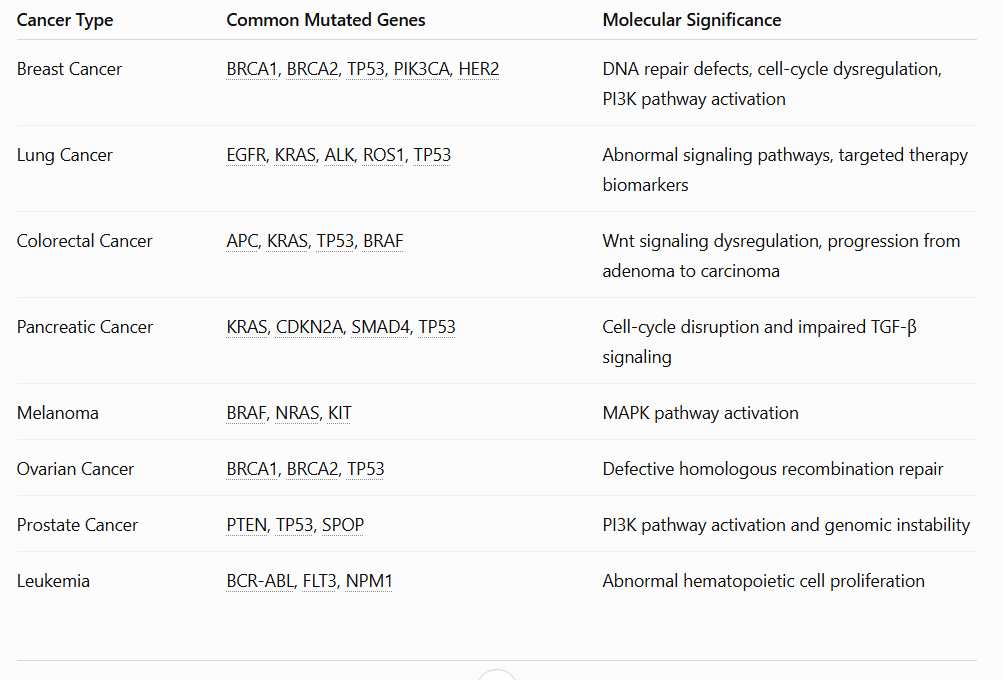
DNA Mutations in Major Cancer Types
Clinical Importance of DNA Mutations in Cancer
DNA mutation analysis has become a cornerstone of precision oncology because it helps to:
Diagnose specific cancer subtypes through characteristic genetic alterations.
Assess prognosis, as certain mutations are associated with more aggressive disease or better outcomes.
Guide targeted therapy, such as inhibitors directed against mutant EGFR, BRAF, ALK, or HER2.
Predict immunotherapy response, particularly in tumors with high microsatellite instability (MSI) or high tumor mutation burden (TMB).
Monitor treatment response and recurrence using circulating tumor DNA (ctDNA) through liquid biopsy.
Overall, understanding DNA mutations enables more accurate diagnosis, personalized treatment selection, and improved monitoring of patients with
cancer, making molecular profiling an essential component of modern oncology.